
Of partners and conspirators
Elizabeth wheeler and her kin
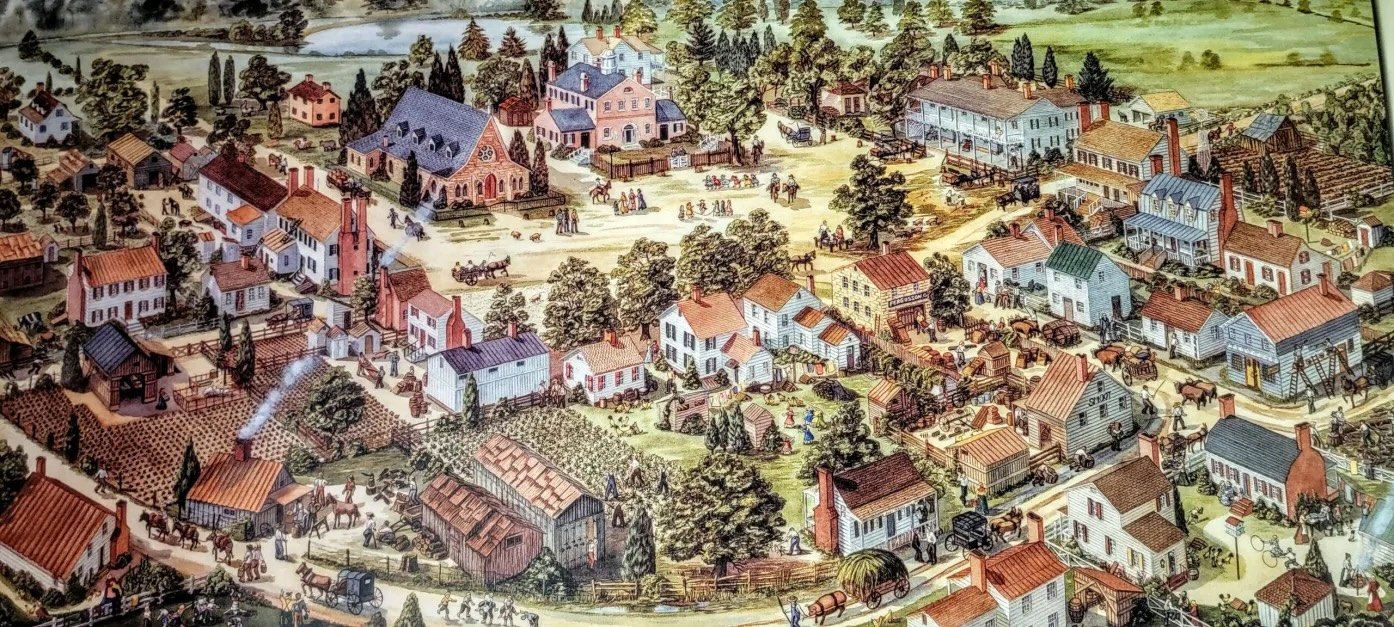
Port Tobacco, Maryland, as it appeared in 1870. Port Tobacco Preserve America Report.
On the morning of July 7, 1865, Elizabeth Wheeler approached the prison to see her partner one final time. She was greeted at the cell by two reverends providing spiritual advice to the condemned prisoner. Whatever was discussed inside the cell was lost to history, yet we can imagine several final requests—and probably a few tears. Elizabeth departed just as stealthily as she had arrived, and the newspapers initially took her for a sister or an “intimate lady friend of the family.” Less than three hours later, George “Andrew” Atzerodt was hanged for his role in the plot against President Abraham Lincoln and his cabinet.¹
Earlier in April, news of Lincoln’s assassination took about a day to reach Elizabeth’s town of Port Tobacco, in Charles County, Maryland, which was an active station in the Confederate underground. Despite the gravity of the president’s murder, Elizabeth did not have time to pay it much attention: she had four daughters under her roof, and George had not provided much help in that regard.
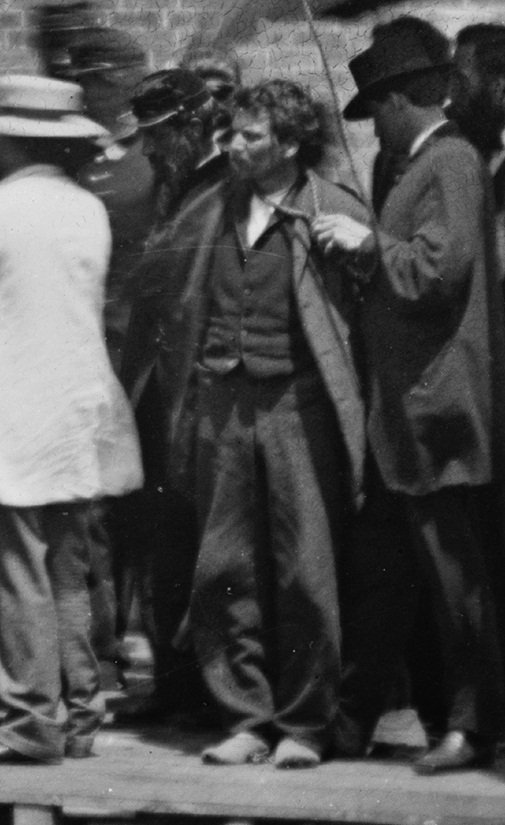
George “Andrew” Atzerodt moments before his execution. Library of Congress.
A few days later came the additional shock of Atzerodt’s arrest for his abandoned assignment to kill Vice President Andrew Johnson inside the Kirkwood House. Edwin Middleton, with whom Elizabeth had a recent dalliance, paid her a visit to break the news. Elizabeth expressed regret for George’s plight, but it is doubtful she knew of the plot. She was likely aware of George’s work as a river pilot, which involved smuggling contraband for the Confederacy across the Potomac River. This partly covered the bills after his carriage repair business with his brother, John, dissolved in 1861, yet it also landed him in the fateful cabal against Lincoln. Still, George had departed Port Tobacco some weeks before the assassination, and he minimized his exposure to the conspirators outside of Washington, D.C.²
Major James O’Beirne, the Washington, D.C., provost marshal tasked with tracking down the conspirators, learned of Elizabeth and ordered his men to watch her house overnight. As his detectives swept through Port Tobacco, they arrested several of George’s colleagues, though not Elizabeth—correctly seeing her as a beleaguered mother. Under questioning, Elizabeth acknowledged that she loved George, yet she was conflicted. She could not completely trust him.³
By now, Elizabeth had good reason to wonder if she would ever find a lasting relationship. More than twenty years earlier, she had married a tailor, Charles H. Wheeler, who died suddenly in 1853—leaving her with five daughters to provide for. Her half-brother, William Boswell, took in her eldest daughter, Betty, but Elizabeth still had her hands full, and a tailoress’s wages were small.⁴
In June 1856, she married Henry O. Rose from Washington, D.C., who worked at the Treasury Department. Less than six months later, Henry departed for work at 6 a.m. and never returned. He faded into history, and his undetermined status complicated Elizabeth’s situation. Under Maryland law, she had to wait at least three years to divorce Henry, and without a divorce she could not safely remarry until December 1863 under the bigamy exception.⁵
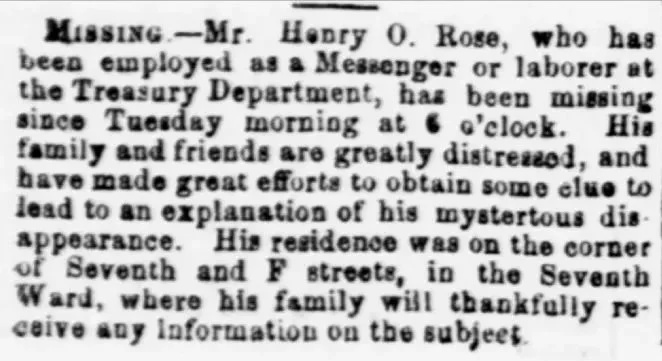
Henry Rose’s disappearance would have decades-long consequences. Evening Star, Dec. 5, 1856.
The Atzerodt family had immigrated to America from Prussia, arriving in Baltimore in 1844. George moved to Port Tobacco to begin his carriage business soon after Henry’s disappearance. Although it is unknown when he met Elizabeth, by late April 1862 they had a daughter, Edith. By having a child while still legally tied to Henry, she was open to a charge of adultery—punishable by a ten-dollar fine. Regardless, in the summer of 1865 Elizabeth had lost her third partner, and she was left alone to care for herself and her daughters.⁶
For reasons unknown, many of the Port Tobacco Times issues from mid-1862 to 1865 have disappeared—depriving us of a valuable source of village news and gossip. We do not know how its residents reacted to President Lincoln’s murder, to George’s follies, or to Elizabeth’s struggles. We can only guess at the childhood taunts Edith endured. To be fair, it is entirely possible the village responded with sympathy.⁷
We do know that Port Tobacco’s reputation after the Civil War suffered as a supposedly treasonous backwater. The colorful and frequently embellishing reporter George Alfred Townsend (GATH) wrote of it after the assassination, declaring, “If any place in the world is utterly given over to depravity, it is Port Tobacco.” He added further color:
Gambling, corner fighting, and shooting matches were its lyceum education. Violence and ignorance had every suffrage in the town. Its people were smugglers, to all intents, and there was neither Bible nor geography to the whole region adjacent. Assassination was never unpopular at Port Tobacco, and when its victim was a northern president it became quite heroic.⁸
GATH also painted Elizabeth as promiscuous, describing her neighbor, Nicholas B. Crangle, as having “succeeded Atzerodt in Mrs. Wheeler’s pliable affections.” GATH reported that Major James O’Beirne questioned Elizabeth without revealing Atzerodt’s crime, and that even after acknowledging his shortcomings, she would not betray him.⁹
Yet GATH was wrong about Elizabeth. There is no evidence she knew about Atzerodt’s plotting. He claimed Elizabeth and Atzerodt had several children together, when in fact Edith was their only child. Nicholas was not her love interest, but he did know her well: he had married Elizabeth’s sister (or half-sister) Margaret Adams in 1860; Margaret died within a few years. He was also a tailor and would later go into partnership with Charles’s former business partner.¹⁰
Nicholas betrayed an affection for the Wheeler family that he attempted to minimize to the detectives. He disapproved of George’s treatment of Elizabeth and had tried in vain to convince them to marry. He also told the detective he did not respect Elizabeth—that he only cared for her children’s welfare. Time would prove this to be false.¹¹
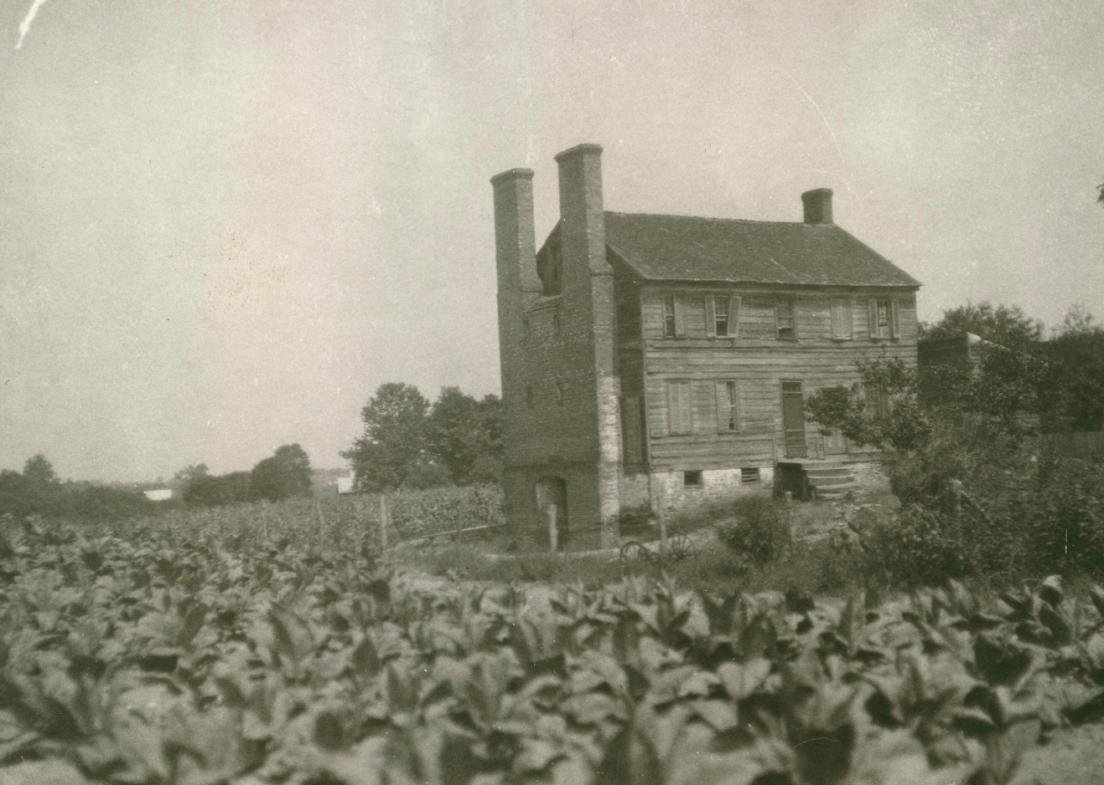
The “Chimney House” of Port Tobacco circa 1930, where Elizabeth Wheeler and George Atzerodt likely stayed.
Nicholas also revealed that Elizabeth feared for her safety, and she pleaded with him to stay in her house. Her brother, James, could not take her in: he already had a family to provide for, and he probably also wanted to avoid undue attention.¹²
Whatever rumors and innuendo Elizabeth encountered after her years with George Atzerodt, by 1870 she had persevered and remained in place. She appeared in the Port Tobacco census as head of household with her fourth daughter, Mary (“Mollie”), nineteen, and her youngest, Edith, seven. For assassination scholars, the 1870 Port Tobacco census has long represented the last trace of Elizabeth and her daughters.¹³
* * *
In actuality, the 1870 Port Tobacco census offers vital clues to Elizabeth’s onward movement. Nicholas was listed incorrectly as “L. D.” three residences away from Elizabeth, along with his wife, Nellie. As it turns out, Nellie is Elizabeth’s third daughter, Nancy, who married Nicholas in 1868—changing him from Elizabeth’s brother-in-law to her son-in-law overnight. The Crangles had an infant daughter named Charlotte (“Lottie”), who appears as “L.,” and rounding out the household was Elizabeth’s fifth daughter, “D.,” boarding there at seventeen.¹⁴
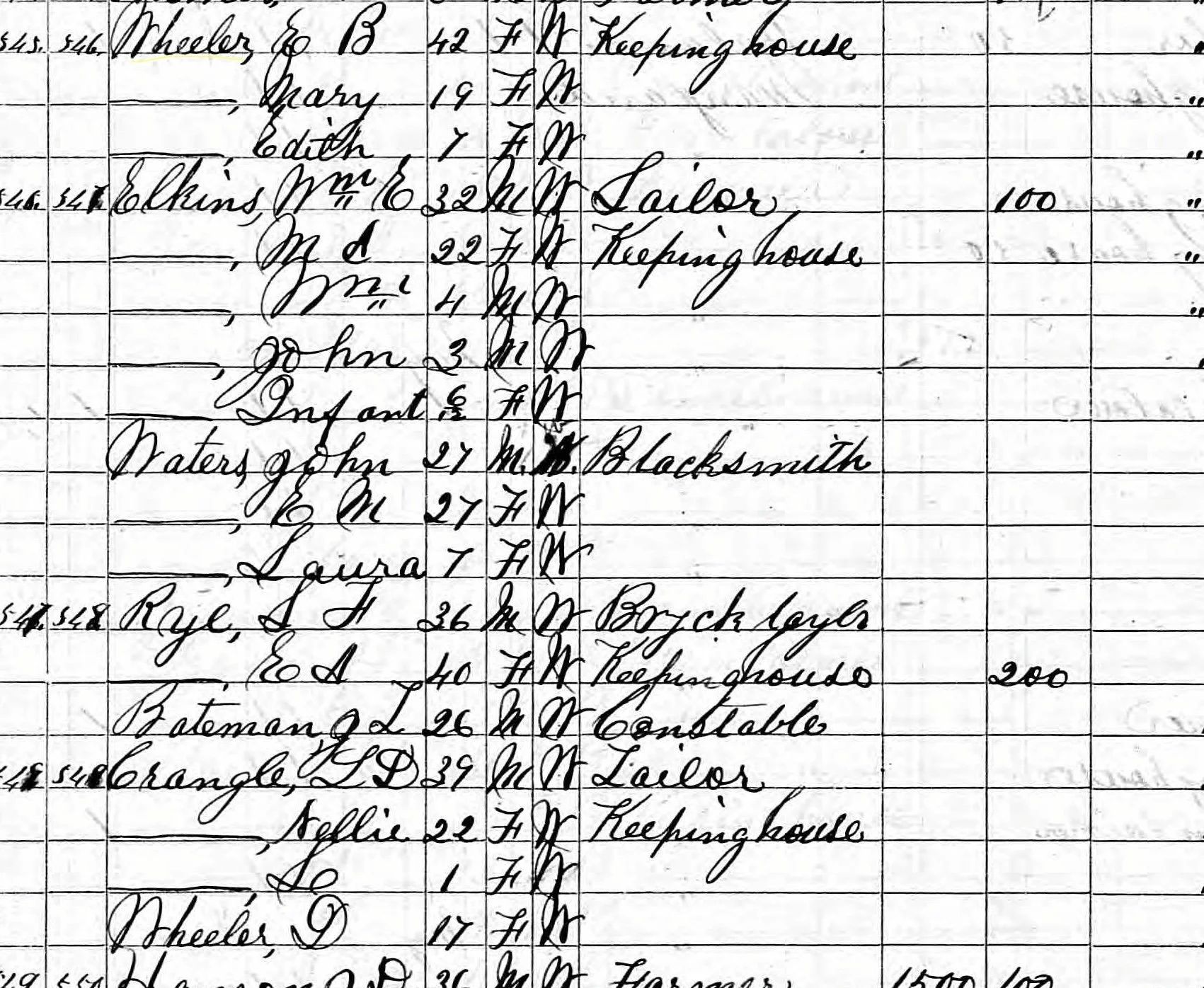
The 1870 Port Tobacco census showing Elizabeth Wheeler and Nicholas Crangle households.
On January 5, 1872, Elizabeth married Thomas “Ralph” Newman, a blacksmith in Port Tobacco. Intriguingly, the marriage register lists “Mary B. Rose” as the bride, revealing the legal reality of Henry’s disappearance, as well as the possibility that Elizabeth went by “Mary.” Although this is possibly a clerk error, it highlights that we do not have any surviving documents—outside of legal records—written in her voice or from family members. The assassination statements simply refer to her as “Mrs. Wheeler” in the polite practice of Victorian society. A month later, her second daughter, Sarah Jane, died at only twenty-five, less than three years after marrying John Button, the future publisher of the Maryland Independent. At some point that year, Elizabeth gave birth to her seventh daughter, Hagar.¹⁵
Within a year of their marriage, Ralph and Elizabeth moved to Washington, D.C., and settled close to Mollie, who had married James Chipley in late April 1871. James was also a blacksmith, and he formed a brief partnership with Ralph, who became a fireman in 1875. Meanwhile, the Crangles had already moved to D.C., with Nicholas as a watchman, possibly guarding the federal buildings near their home on East Capitol Street. It was low pay, yet it provided steady work. He died in mid-January 1874, in his early forties. The next year, the Newmans, Chipleys, and Nannie Crangle all lived at 1118 New Jersey Ave. S.E.¹⁶
By the end of the decade, Elizabeth’s extended clan was firmly established in and around the Capitol Hill area. Ralph was a fireman for Truck A, living with Elizabeth, the still-widowed Nannie Crangle, and their daughter Hagar. The Chipleys were ten minutes away at 808 3d St. S.E., and Edith resided nearby on Pennsylvania Ave. S.E. The Newmans and Crangles would later marry and bury from the Fourth Street Methodist Church, and Edith shared a doctor (one of the city’s physicians to the poor) with Elizabeth.¹⁷
The 1880 Washington, D.C., census revealed something else entirely. A tick mark in the “deaf and dumb” column next to Elizabeth indicates she had lost her hearing by her fifties. (That census also took supplemental schedules of the blind, the “insane,” homeless children, prisoners, and others.) The decade wore on, and on August 28, 1886, Elizabeth’s daughter, Mollie, died at thirty-four and was buried at Congressional Cemetery.¹⁸
Five weeks later on October 2, Elizabeth, who had been suffering from uterine cancer for several months, passed away. Two days later, she was buried three rows away from Mollie. It had been an arduous life for Elizabeth, raising seven daughters by three men across four marriages or partnerships, and enduring several crises. At the very least, she had found a worthy husband in Ralph in her final years.¹⁹
The extended family received a third shock in late December 1886, when Mollie’s husband, James Chipley, passed away, leaving six orphans—including a daughter who was under a year old.²⁰

Elizabeth’s 1880 census in Washington, D.C., indicating in upper right she was deaf.
* * *
For those steeped in the Lincoln assassination, it is natural to focus on the “consequential” people who shaped its history: the presidents, the cabinet members, the conspirators, and their pursuers. Yet in doing so, we miss the compelling narratives of those it affected—and we tend to neglect the everyday heroes in our midst.
Thomas R. Newman had been a firefighter for fifteen years when, on December 19, 1890, his Truck A crew responded to a fire at a drug store at 11th and F streets. They did not notice a cable car speeding downhill until it was too late—the gripman applied the brakes in vain as it crashed into the horse-drawn firetruck at 7th and D Streets. Nearly all of the crew were thrown off the truck, and Ralph broke his leg near the ankle. He languished in the hospital for two months—his leg never mending. During this time, his wife, Mary, whom he had married in early 1889, gave birth to their second child. In a last-ditch effort to save his life, the doctor amputated Ralph’s leg, but it was of no avail, and he died on February 21, 1891. In the delirium of his final moments, he kept repeating, “Box 135! Box 135!”—the call box number used to report the fire. In his final moments, Fireman Newman’s mind held fast to his solemn duty to protect.²¹
Ralph’s death garnered an outpouring of sympathy throughout the District of Columbia, with Fire Chief Joseph Parris using it to champion a public bill to fund a more generous death benefit than the paltry amount funded from the firemen’s pay. Public support skyrocketed in April when the newborn Newman passed away, with the Washington Postleading the charge to raise funds for Mary. Ultimately, the public raised $4,388 for the Newman Relief Fund—equal to more than $164,000 in contemporary dollars, worth several years of fireman pay. More importantly, the Washington Post purchased a new home for Mary at 706 4th Street S.E., and District commissioners provided her a $30 monthly widow’s pension.²²
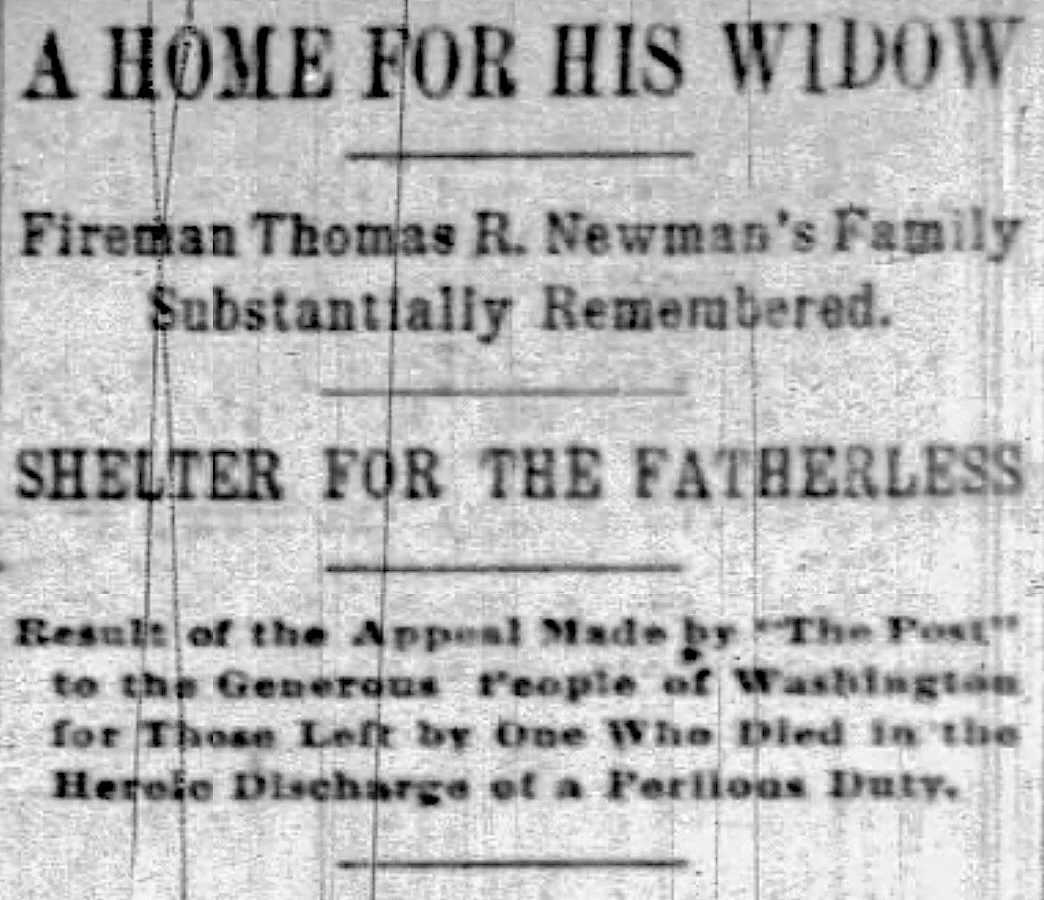
Fireman Newman’s death led to an outpouring of support in D.C. Washington Post, May 19, 1891.
As Elizabeth’s youngest child, Hagar forged her own path. On March 20, 1902, Hagar and her groom-to-be, Burton Leffingwell, rode the electric trolley from D.C. out to Rockville, Maryland, for a quick wedding at the Methodist parsonage. They arrived alone, and as soon as the ceremony was finished, they boarded the car and returned to the city. The Leffingwells eventually moved to Delaware County, Pennsylvania, where they lived until Hagar died under tragic circumstances in 1916. She had been suffering from kidney disease for a year when, five months into her sixth pregnancy, she delivered a stillborn boy; Hagar passed away the following day.²³
Since the genealogical records do not indicate another person in Ralph’s or Elizabeth’s family named Hagar, we can only speculate about their motivation for choosing that name. Given the family’s strong church ties, Elizabeth was likely moved by the biblical story of Hagar—an enslaved Egyptian woman who bore Abraham a son and was subsequently cast into the wilderness with him, until God heard the boy’s cry and saved them.²⁴
Hagar was buried in Arlington Cemetery in Drexel Hill, Delaware County, Pennsylvania, along with her son. These picturesque grounds also hold the final resting place of Edith, who—like her mother—has, until now, remained untraced beyond the 1870 census. As we uncover Edith’s journey from Port Tobacco to Pennsylvania, we will encounter many fascinating and unexpected turns along the way.²⁵
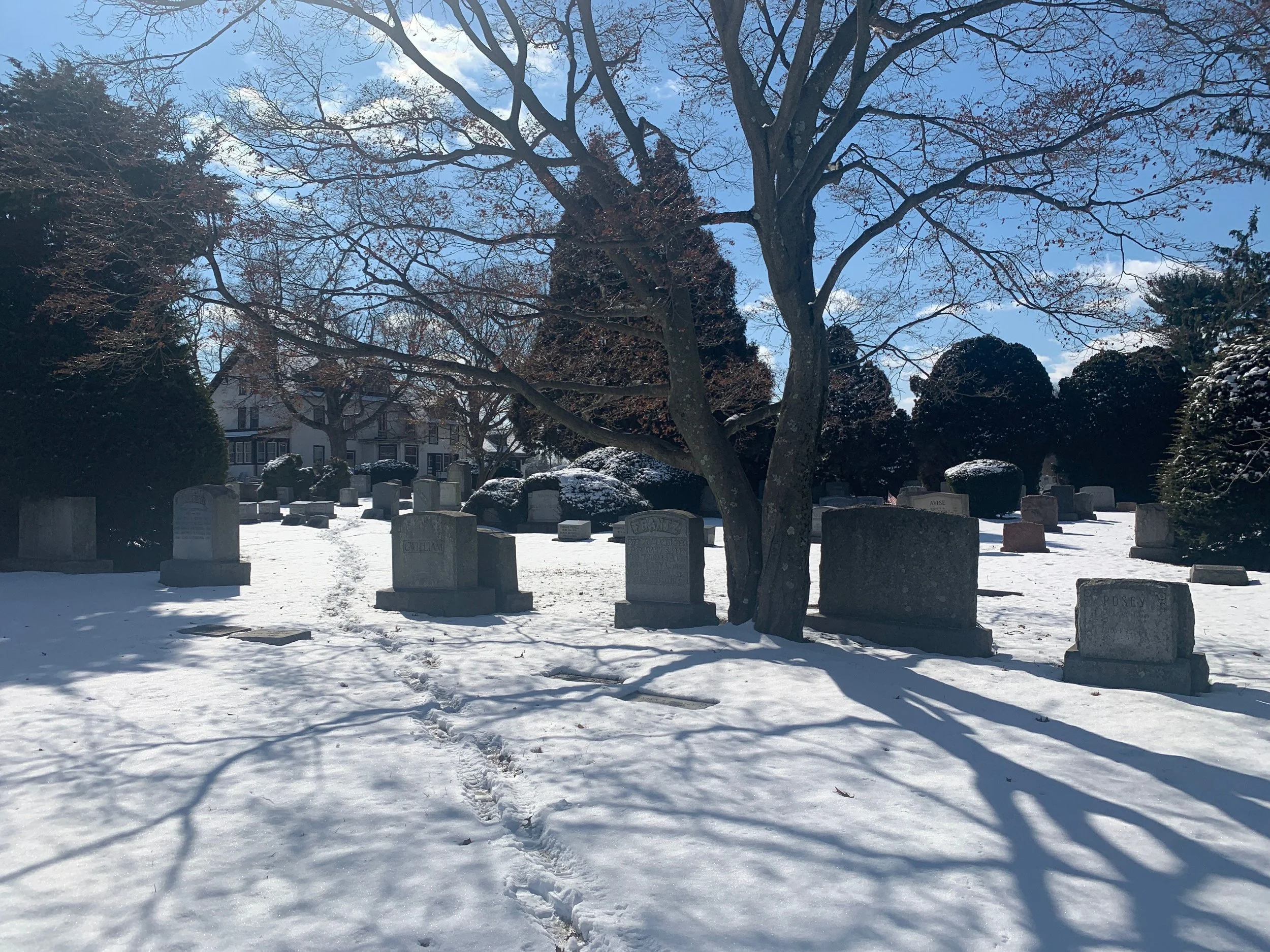
Arlington Cemetery, Drexel Hill, Pennsylvania. Find a Grave.
Sources and Notes
1. The reverends were the Lutheran John George Butler and Warren Weaver Winchester, who, according to family tradition, accompanied Atzerodt on the scaffold. “Dying Statement of Atzerodt,” Baltimore American and Commercial Advertiser, July 8, 1865; “Confession of Atzerodt,” ibid., July 10, 1865; https://lincolnconspirators.com/picture-galleries/atzerodt/atzerodt-3-reading-the-death-warrant/.
2. Statement of Edwin Middleton, May 12, 1865, Office of the Provost Marshal, D.C., Letters Received and Statements of Evidence Collected by the Military Commission, “M” R.B. (J.A.O.) P. 60, NARA M599, RG 153, reel 5, frames 202–207 (Fold3 images 7341136–7341141); printed in William C. Edwards and Edward Steers Jr., eds., The Lincoln Assassination: The Evidence (Urbana, 2009), 896–98; Michael W. Kauffman, American Brutus: John Wilkes Booth and the Lincoln Conspiracies (New York, 2004), 162; Statement of Nicholas B. Crangle, [April–May] 1865, “A” Ev. B. (J.A.O.) P. 6, NARA M599, RG 153, reel 4, frames 109–116; printed in Edwards and Steers, 402–4; “Confession of Atzerodt,” Baltimore American and Commercial Advertiser, July 10, 1865; Joan L. Chaconas, “President’s Message,” Surratt Courier, vol. 13, Oct. 1988, pp. 1–3.
3. Major James O’Beirne diary, Heritage Auctions, Auction 6128, lot 42174, https://historical.ha.com/itm/political/small-paper-pre-1896-/-abraham-lincoln-james-o-beirne-s-diary-detailing-the-pursuit-of-booth/a/6128-42174.s.
4. “Obituary,” Port Tobacco Times, March 31, 1853, p. 2; 1850 U.S. Census, Charles County, Md., Allen’s Fresh District, p. 219 (stamped 437), dwelling 48, July 13, 1850; Betty with William Boswell in the 1870 and 1880 censuses, Charles County, 2nd District.
5. “Married,” Port Tobacco Times, June 19, 1856, p. 2; “Missing,” Evening Star (Washington, D.C.), Dec. 5, 1856, p. 3; The Maryland Code: Public General Laws (1860), Art. 16, §§24–27, and Art. 30, §11 (Archives of Maryland Online, vol. 145, pp. 75–77, 207–8).
6. Passenger list of the brig Apollo, from Bremen, arrived Baltimore, June 26, 1844, steerage passenger no. 4, “John H. Atzroadt” [indexed as Metzroadt], smith, of Seebach, with seven others; Passenger Lists of Vessels Arriving at Baltimore, 1820–1891, NARA microfilm publication M255, roll 4, list 34; Records of the U.S. Customs Service, Record Group 36, National Archives, Washington, D.C. “Confession of Atzerodt,” Baltimore American and Commercial Advertiser, July 10, 1865; 1900 U.S. Census, Delaware County, Pa., Ridley Township, ED 180, sheet 11B (“Apr. 1862”); The Maryland Code: Public General Laws (1860), Art. 30, §1 (Archives of Maryland Online, vol. 145, p. 205).
7. Roberta J. Wearmouth, Abstracts of the Port Tobacco Times and Charles County Advertiser. Volume 2: 1855–1869, i.
8. George Alfred Townsend, The Life, Crime, and Capture of John Wilkes Booth: And the Pursuit, Trial and Execution of His Accomplices (New York, 1865), 52.
9. Ibid.
10. Nicholas Crangle mentions Adams is Elizabeth’s maiden name, but hedges between his former wife being either Elizabeth’s full or half-sister. Elizabeth’s middle initial implies the Boswell connection, along with William taking in her daughter, Betty. However, it is still not established whether James Adams or William Boswell were her full or half-brothers. Statement of Nicholas B. Crangle, NARA; “Murdoch & Crangle, Tailors,” Port Tobacco Times, July 16, 1868, p. 3.
11. Statement of Nicholas B. Crangle, NARA.
12. Ibid.
13. 1870 U.S. Census, Charles County, Md., 3rd District, Port Tobacco P.O., p. 81 (stamped 151), enumerated Aug. 16, 1870, dwelling 545, family 546, lines 20–22; the Crangles at dwelling 548, family 549, lines 34–37.
14. The author has not yet traced the identity of “D.”; ibid.; Charles County Circuit Court, Record of Marriages 1865–1886, Maryland State Archives film CR 122590, image 049 (Crangle–Wheeler, March 1868; Crangle entered as a widower). Lottie’s birth, Dec. 1869: 1900 U.S. Census, D.C., Hancock household.
15. There is no evidence to suggest a genetic predisposition to give birth to a particular gender. It is possible (although no record suggests it) that she had a stillborn male. The odds of having seven daughters in a row (with an observed birth ratio of 48.7% for girls) are 1 in 154. “Married,” Port Tobacco Times, Jan. 12, 1872, p. 2; “Obituary,” ibid., Feb. 16, 1872, p. 2; Record of Marriages 1865–1886, Maryland State Archives film CR 122590, image 082; 1880 U.S. Census, Washington, D.C.; “The Maryland Independent,” Maryland Independent (Port Tobacco, Maryland), Dec. 9, 1874, p. 1.
16. Port Tobacco Times, May 5, 1871, cited in Wearmouth, Volume 3, p. 50. Boyd’s 1873 Washington, D.C. Directory, p. 143; ibid., 1875, pp. 141, 160–61, 390–91; ibid., 1876, p. 406; “Our Fire Guardians,” Washington Chronicle, May 6, 1875, p. 5; Wesley E. Pippenger, District of Columbia Interments (Index to Deaths), 1855–1874 (Westminster, Md., 1999), p. 140; Record of Marriages 1865–1886, Maryland State Archives film CR 122590, image 050, Apr. 27, 1871.
17. 1880 U.S. Census, Washington, D.C., SD 17, ED 66, p. 1 (stamped 415), June 1, 1880, house 307 A St. N.E., lines 47–49; ED 74, p. 41 (stamped 110), June 11, 1880, house 660 Pa. Ave. S.E., lines 3–5 (Edith); Boyd’s 1879 (Chipley, 808 3d St. S.E.); 1880 U.S. Census, Brandywine District, Prince George’s County, Md., ED 131, p. 27; Washington Post, Feb. 22, 1891, p. 1 (Truck A); D.C. Record of Marriages (Hancock–Crangle, Aug. 22, 1888; Newman–Spedden, Jan. 10, 1889, p. 464; Hardman–Newman, Sept. 7, 1891, p. 123), all by Rev. W. M. Ferguson of Fourth Street M.E.; Boyd’s, “Churches,” p. 967; Dr. W. P. C. Hazen, 511 East Capitol St., signed birth returns (D.C. nos. 31661–62, Dec. 1882), death certificate (no. 38224, July 1883), and Elizabeth Newman’s death certificate (no. 53677, Oct. 1886); Boyd’s 1881, “Physicians to the Poor.”
18. The supplemental documents were also recorded in the 1890 census, most of which were destroyed in two separate fires. 1880 U.S. Census, D.C., ED 66, p. 1, line 47, col. 17 (“Deaf and Dumb”); Mary: Congressional Cemetery interment record (d. Aug. 28, 1886; Section 6, Range 16, Site 229).
19. Elizabeth: D.C. Certificate of Death no. 53677, Congressional Cemetery, Section 6, Range 13, Site 229.
20. D.C. Certificate of Death no. 54743 (“James P. Chipsley” [sic], d. Dec. 30/31, 1886, Washington Asylum Hospital; buried Congressional Cemetery, Section 6, Range 16, Site 229a); Marie: 1910 U.S. Census, Atlanta, Ga., Ward 9, ED 108, sheet 6A.
21. Congressional Cemetery has two burial records for Thomas R. Newman: one for the majority of his body and one for his leg. “Serious Results of a Fire,” Evening Star, Dec. 20, 1890, p. 2; “Fireman Newman Dead,” Washington Post, Feb. 21, 1891, p. 1; “A Brave Man’s Family,” ibid., Feb. 22, 1891, p. 1.
22. “Fireman Newman Dead,” Critic and Record (Washington, D.C.), Feb. 21, 1891, p. 3; “Fireman Newman’s Children,” ibid., April 11, 1891, p. 2; “A Home for His Widow,” Washington Post, May 19, 1891, p. 2; “Guardian Asked for Minor Heir,” Washington Post, Jan. 5, 1900, p. 10.
23. Evening Star, Mar. 22, 1902, p. 2; “Clifton Heights,” Delaware County Daily Times, May 16, 1916, p. 2; Pennsylvania Department of Health, Certificates of Death, file nos. 50773 (Hagar Leffingwell, May 14, 1916: nephritis, 1 yr.; pregnancy, 5 mos.) and 50774 (“Stillborn Foetus Leffingwell,” May 13, 1916).
24. Genesis 16:1–16; 21:9–21 (King James Version).
25. Edith’s later identity and burial record will be documented in the second article of this series. Her identification rests on the convergence of records and is not yet confirmed by a document naming her mother. As of the time of this article being published, the author is awaiting a trove of documents from the National Archives that should establish the connection. However, all of Edith’s documentation in this article series fits, and no other candidates have been found. Arlington Cemetery, Drexel Hill, Pa., burial records, Woodlawn section, lot F-9 (correspondence with the author, Sept. 2026). Edith, Certificate of Death, file no. 19046 (died 1 Feb. 1922, Morton; buried Arlington Cem., 4 Feb. 1922); Arlington Cemetery, Sunnyside section, lot 285.