
The conspirator’s daughter
an edith of her own
Attila Lisinsky on Unsplash
Compared with John Wilkes Booth and the other conspirators, George “Andrew” Atzerodt has received far less attention for his role in the Lincoln assassination. At the time of his hanging on July 7, 1865, Atzerodt had a partner, Elizabeth Wheeler, with whom he had lived in Port Tobacco, Maryland. Less well known is that George and Elizabeth had a three-year-old daughter, Edith. All traces of Elizabeth and Edith had vanished after the 1870 U.S. census—until now.
In part one of this series, we unveiled Elizabeth Wheeler and her extended family from the time of Atzerodt’s arrest to her death in Washington, D.C. Now we will reveal the life of Edith, the little-known daughter of the Lincoln conspiracy.
* * *
When Thomas and Elizabeth Newman departed Port Tobacco, Maryland, in 1873, they left a village that was previously the second-largest river port in Maryland, but by the Civil War had dwindled to only a few hundred people due to soil erosion and river siltation. They departed around the same time the Baltimore and Potomac Railroad built a new station at Pope’s Creek, bypassing Port Tobacco and creating what would become the new Charles County seat at La Plata. Edith, eleven at the time, would have to say goodbye to her friends and begin a new chapter in Washington, D.C. 1
Edith came of age within four years of arriving in the Capitol Hill neighborhood of Washington, D.C. In November 1877, she married William W. Beall in a no-frills ceremony performed by the Reverend Jesse Shreeve, pastor of the North Carolina Avenue Methodist Protestant Church. Young brides were fairly common in that era (Elizabeth herself had married Charles Wheeler in her mid- to late teens), and they often married older, well-established grooms. But in the Bealls’ case, William was also young. Curiously, the 1880 Washington, D.C., census shows him living with his parents at age sixteen on Ninth Street, and a few days later he is enumerated as twenty years old, living with Edith and their son, Harry, ten months old, at 660 Pennsylvania Avenue S.E. 2
On her 1877 marriage license, Edith appeared under the Rose surname dating back to Elizabeth’s 1856 marriage to Henry O. Rose who disappeared six months later on his way to the Treasury Department where he worked. Edith’s marriage corresponded with her mother’s declining health. Elizabeth was losing her hearing while raising her youngest daughter, Hagar (five years old), with the help of her daughter, Nannie, who had been widowed in her mid-twenties. 3
Edith’s years married to William Beall can only be described as a nightmare. On December 1, 1882, Edith gave birth to twin daughters, Edith and Effie. Seven months later, young Edith died of meningitis, and her grieving mother published a poem in the Evening Star:
To the bird of my bosom, fluttered up to the dawn,
A window was open, my darling was gone.
A truant from time, from tears and from sin,
For the angels on watch took the wanderer in.
By Her Mother
Two days after the funeral, Edith took Harry and Effie on a getaway to Fauquier County, Virginia. William was notably absent, and two weeks later the Evening Star reported his arrest for threatening Edith with violence. He was released on his personal bond to keep the peace for six months. Five days later, the same newspaper reported that Edith had accused a wagon driver of stealing a gold chain from her. He had been hired to move her furniture, perhaps suggesting a temporary separation. 4
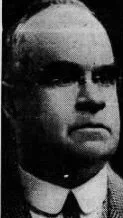
Edith’s first husband, William W. Beall, from Baltimore Sun, January 2, 1934.
William began his career as a barber on Capitol Hill, and he eventually added dentistry to his repertoire. This may seem a random combination, but historically barbers performed bloodletting, lancing, setting bones, amputations, and pulling teeth. University physicians considered manual work beneath them, and barbers possessed all the requisite tools: razors, chairs, basins—and steady hands. Indeed, the red-and-white barber pole signifies blood and bandages. Washington, D.C., did not have a dental licensing law until 1892, but William studied medicine at Howard University in 1888. The next year, he was advertising nitrous oxide gas, chloroform, or ether for painless extractions. 5
William’s medical connections would prove fateful. In the nineteenth century, most universities and medical schools could not legally obtain enough cadavers for training, and this spurred the grisly practice of robbing recent graves. It required a person willing to perform this macabre task and a doctor paying for the corpses and lending assistance to any grave robber who was caught—either by providing an alibi or paying legal fees, fines, and bail. This was the basis for the cemetery scene in The Adventures of Tom Sawyer, where Tom and Huck witness a grave robbing turned murder. 6
On the night of December 20, 1889, police found the bodies of two women inside a carriage that had been parked outside Potter’s Field, a burial place for impoverished people bordering Congressional Cemetery and a frequent target for grave robbers. One of the women, Alvania Cheek, had recently died at twenty-four and was buried at the Congressional Cemetery along with her days-old infant. Doctor Arthur C. Adams, an anatomy teacher at the National Medical College, inquired about the carriage, which led to his becoming a suspect. He was formally charged and later named William as the carriage owner. When detectives pursued William at his home, they learned he had fled to his brother’s farm in Washington Grove, Maryland. 7
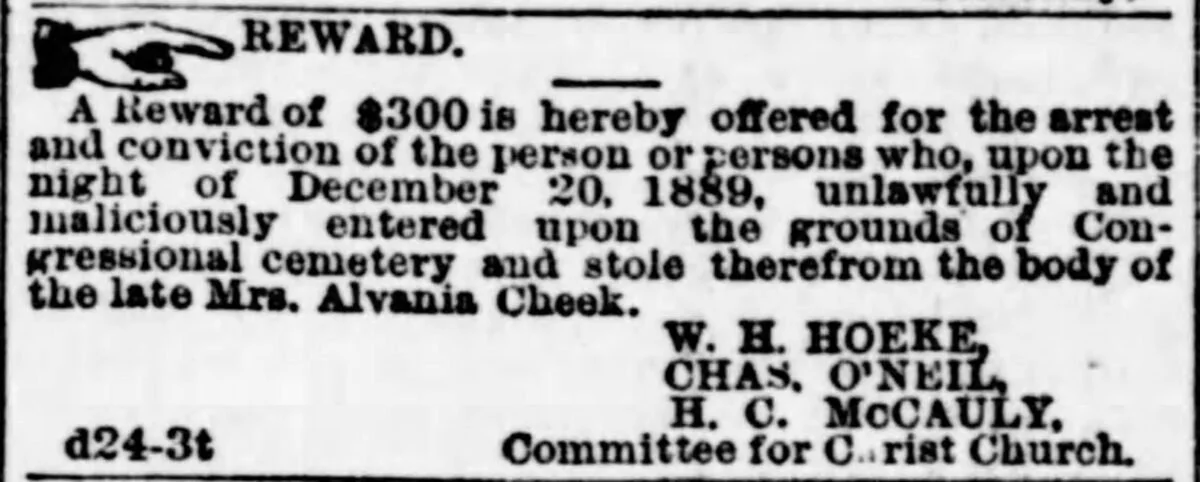
A ghoulish crime. From the Evening Star, December 24, 1889.
On Christmas Day, the officers arrived at the farm, saw William flee into a barn behind a pig pen, but were unable to find him. Not wanting to be a rude host, his brother offered the officers cake and wine, but they declined and returned home. William turned himself in on December 27, explaining he simply wanted to avoid arrest on Christmas Day so he could enjoy a visit with his family. Yet he did not visit his entire family: the Washington Post reported Edith was very ill at this time, and William’s mother traveled from Maryland to care for her in William’s absence. 8
On January 4, 1890, the case reached trial. Mr. Cheek, shaking as he spoke, testified that the robber had stolen his wife’s jewelry and had thrown the infant corpse back into the smashed coffin on its head. The final witness claimed he had helped William get bodies from Potter’s Field, and that they averaged three trips there per week. On January 8, William was convicted, fined $400, and sentenced to six months in jail. 9
The trial introduced a defense witness who would prove consequential to the story. Robert J. Ewig, a tailor with German immigrant parents, offered the alibi that he had slept in the same room with William the night of the grave robbing—both men having retired early that night. Robert noted he had been without work as a tailor and had boarded at the Beall house over the previous year. The prosecution became suspicious of Robert, highlighting his “hobnobbing” with prosecution witnesses to influence his testimony, and they openly accused him of being William’s accomplice. He was not charged, however. 10
In keeping with the sensational nature of the trial, William’s conviction led to nationwide headlines of “A Ghoul Sentenced.” The Washington Post also provided a vivid description of Robert’s appearance: “Ewig’s face is the color of a streak of moonlight shining on a tombstone, while his hair is pure white and stands in every direction, like the quills of a fretful porcupine.” 11
William appealed his conviction, and the new case commenced in June, with William taking the stand this time—offering a weak excuse for why he didn’t report his horse and buggy to the police after he alleged it was stolen. Two jurors voted to acquit, and when the jury could not reach a verdict, the judge declared a mistrial. 12
In the summer of 1891, Edith filed for divorce on the grounds of adultery and non-support. She accused William of having an affair with a recently widowed woman and of deserting her and their two children in February 1889. This timeframe corresponds with a six-week trip he took to Washington Territory, but it implies other separations. In mid-January 1892, the judge granted Edith’s request and awarded her custody of Harry and Effie. 13
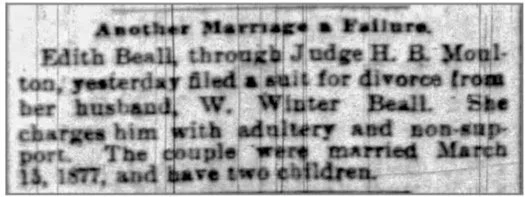
Edith divorces William Beall, from Washington Post, June 3, 1891.
The following year, Edith moved to Pennsylvania, settling in the Swarthmore area of Delaware County. After so much drama in the nation’s capital, she moved to the Keystone State with Harry, Effie, and her new husband, Robert J. Ewig. Marriage records are missing for Edith and Robert, and they may simply have lived as husband and wife, given that Pennsylvania recognized common-law marriages. Later census records suggest they were already together before she divorced William. 14
The Ewig family took root in Swarthmore, with Robert selling houses and land throughout the county, and Edith plying the needle trade from her home. Although Harry was born to William Beall, he readily adopted the Ewig name, and he was devout from an early age. Edith gave birth to a son, Otto, in 1894, and Titus arrived in 1902. It is unknown if Edith persuaded other family members to settle in Pennsylvania, but by 1904, three of Elizabeth’s kin had done so, including Edith’s half-sister, Hagar, who moved to Clifton Heights, within four miles of the Ewigs. 15
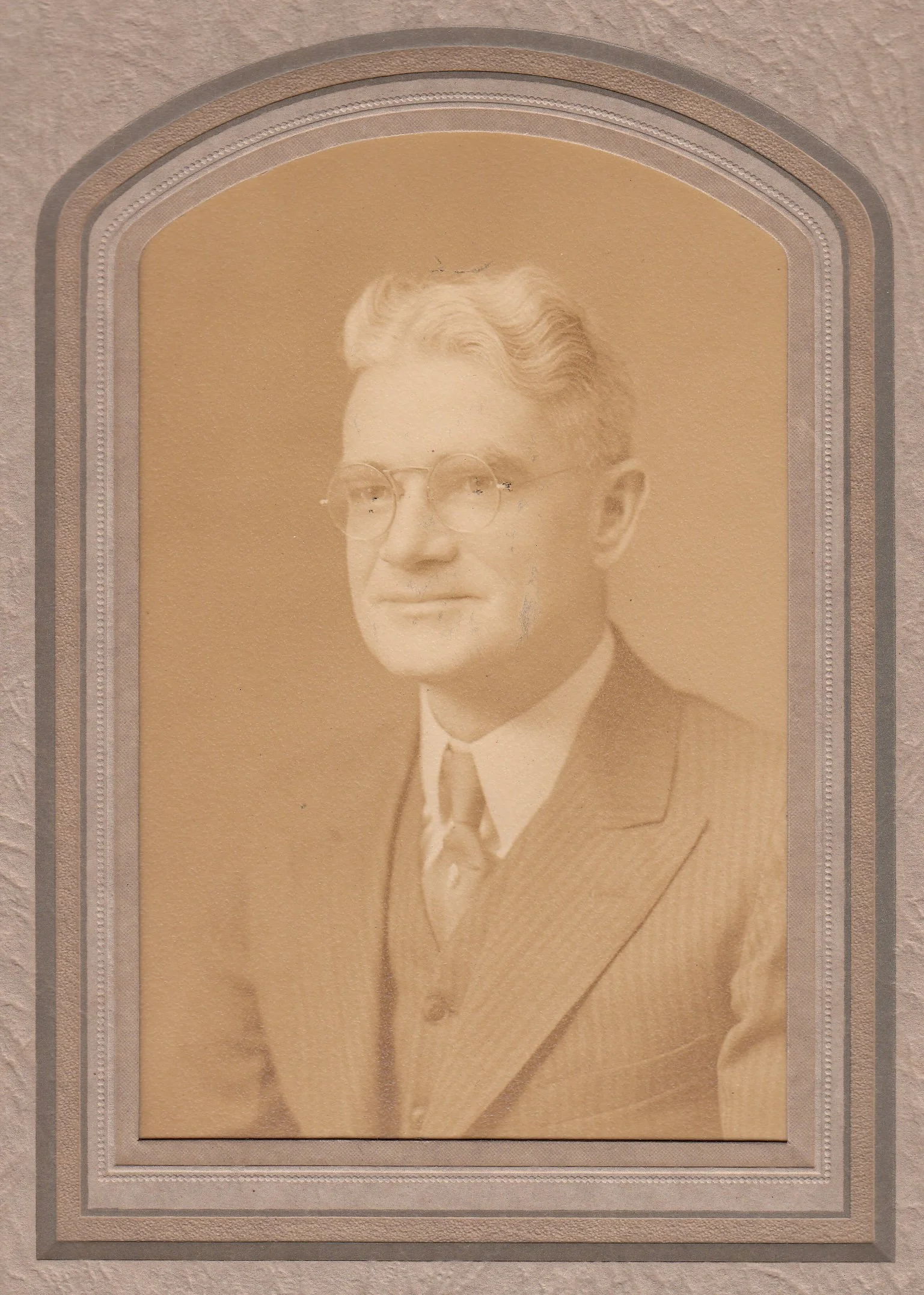
Edith’s son, Harry Ewig, courtesy of Jeffrey MacManiman.
Life did not slow down for Edith. In 1906, a heavy storm passed through Swarthmore, and a bolt of lightning hit the Ewigs’ house, knocking all but Robert unconscious. He called a doctor, who was able to resuscitate the family—Edith regained consciousness and was distraught at the extent of the damage. The bolt split the entire length of the chimney down to the cellar, where it tore up the floor. Strangely, it also broke open a safe and scattered its contents throughout the room—but nothing suggests any funny business. Two years later, tragedy struck the household as her son, Otto, drowned at age fourteen. He was swimming with friends and pushing a canoe across a stream when he was stricken with cramps and went under. 16
With so much happening for Edith in Pennsylvania and Washington, D.C., it probably felt like a century since her early years in Port Tobacco as daughter to Elizabeth and the condemned Lincoln conspirator, George Atzerodt. Yet the 1910 U.S. census provides a brief reminder of this consequential event in America’s history—a momentary echo of Atzerodt. That census lists her mother’s birth in Maryland and her father’s birth in Germany. Censuses are notoriously variable over the decades, but this seems to be the one record that hints at the truth—albeit without revealing too much. 17
Edith’s final years were equally difficult. The 1920 census showed her still married, but as head of household raising her youngest son, Titus, at seventeen. She appears as a seamstress—continuing the path of her mother, Elizabeth, and the trade she had practiced since the 1840s. 18
Meanwhile, the 1920 census also shows Robert Ewig as married and a tailor, but living with another family in Washington, D.C. He was under his sister’s roof, together with a German woman, Pauline, a son, Robert (five), and a younger daughter. By the time of Robert’s death in 1928, his death notice calls him the “beloved husband of Paula Ewig.” 19
In December 1921, Edith became seriously ill, and her oldest son, Harry—now a Presbyterian minister—went to see her. She had been suffering heart troubles over the past year, and in her last few days her lungs had filled with fluid. Edith passed away on February 1, 1922 at fifty-nine. Her daughter, Effie, incorrectly listed Edith’s birth year on the death certificate as 1865—perhaps biased toward that pivotal year by Edith’s blood connection to the Lincoln assassination. 20
* * *
The immediate question in our fascination with Edith as George Atzerodt’s daughter is whether she has any living descendants. Effie had one son, Harry Zeising, who died in 1960 without any children. Harry Ewig’s daughter, Violet, died in 1989—also without children. As I continued my research from Tampa, Florida, my heart began to race as I traced Edith’s youngest child, Titus, who moved to nearby Saint Petersburg in 1949. Was I going to inform somebody in person that they were related to George Atzerodt? But alas, Titus Ewig died in 1989 without any children. One hundred and twenty-four years after George Atzerodt was hanged for his role in the Lincoln assassination, his final living issue passed away. 21
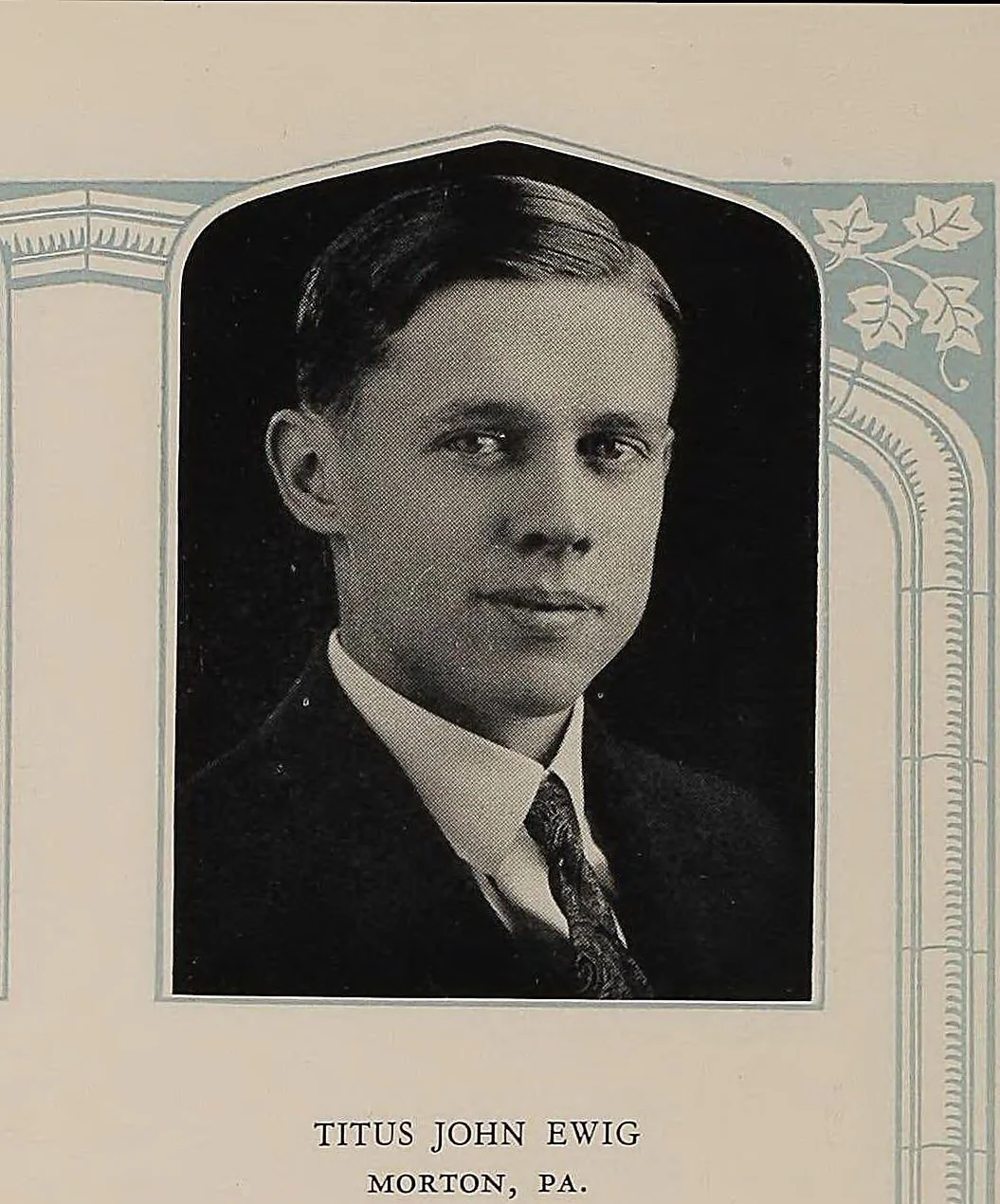
End of the line: Edith’s son, Titus Ewig. Ancestry.com.
The misfortunes Edith faced remind us that despite our interest in the Lincoln assassination, George Atzerodt likely did not occupy much space in her mind, especially as time wore on. She probably retained only a few memories of him, if any at all, and she left Port Tobacco for an entirely different world in Washington, D.C. There are no indications the Atzerodts kept in touch with Elizabeth or Edith after George’s execution, and there is no guarantee she told her children about her father. Had there been living descendants today, we cannot assume they would know about their family’s unique genealogical connection.
It may seem ironic that the breakthrough in finding both Elizabeth and Edith occurred through marriage records carrying the Rose surname. Indeed, Elizabeth married Henry O. Rose nearly a decade before the Lincoln assassination. Yet the ripple effects of his sudden disappearance in December 1856 were visible as late as 1968, when Effie’s death certificate listed her mother’s maiden name as Edith Rose. 22
This leads to a natural question: what happened to Henry O. Rose? We will explore this in the final article of the series.
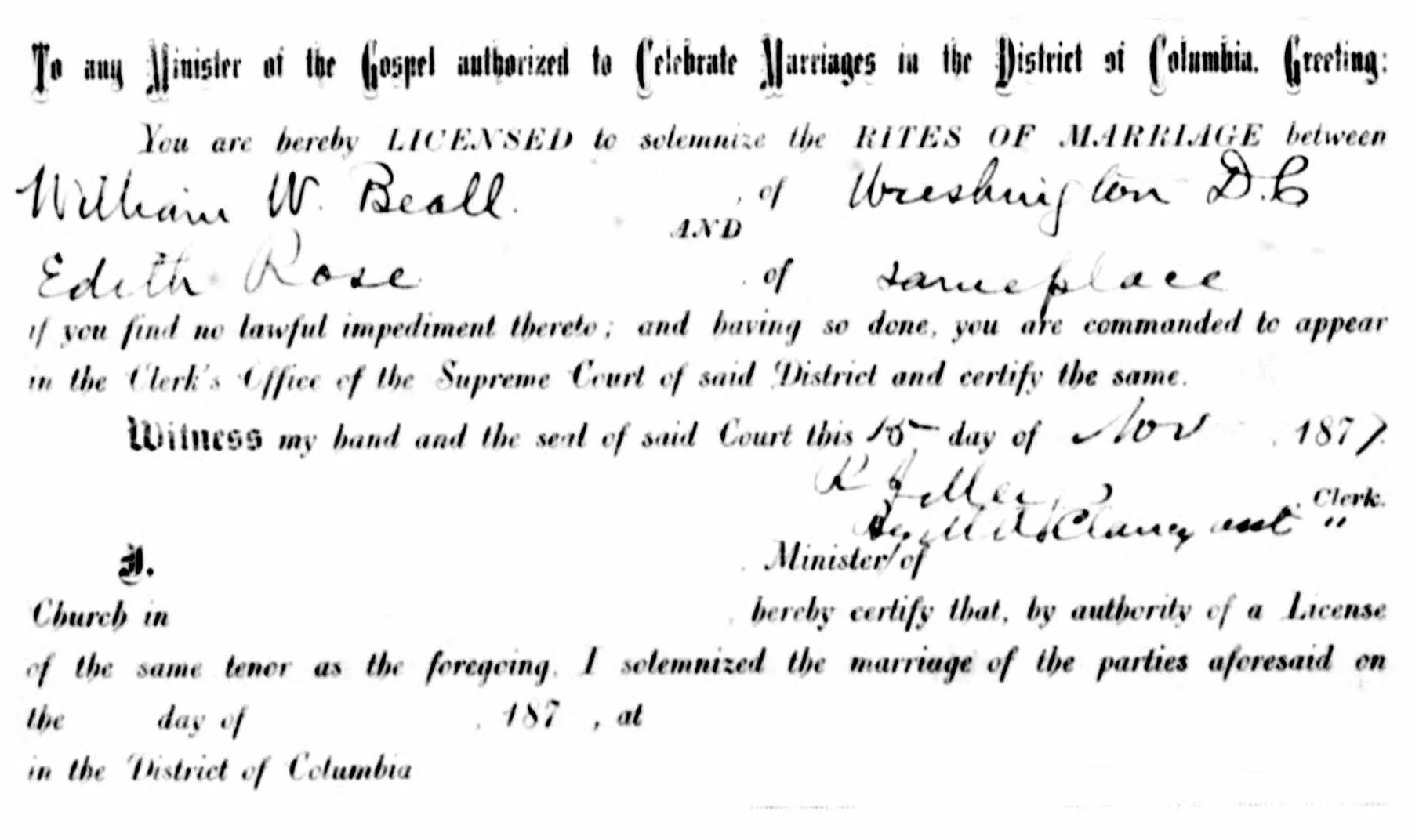
Back to the beginning: Edith Rose’s marriage license, November 15, 1877. Ancestry.com.
Sources and Notes
1. Although no surviving document names Elizabeth as Edith Beall’s or Edith Ewig’s mother, the records line up: the Rose surname carried from her 1877 marriage license to her children’s death certificates, a Maryland birth about 1862, an address a few blocks away from Elizabeth, a shared doctor, a German-born father in the 1910 census, and Elizabeth’s daughter Hagar settling four miles away, with both Edith and Hagar buried at Arlington Cemetery in Delaware County, Pennsylvania. No other candidate was found among the thousands of records scanned. The National Archives has yet to deliver the divorce case file of Beall v. Beall, whose depositions may name Edith’s family and settle the question. “Witnesses in State’s Cases, 1872—November Term,” Port Tobacco Times and Charles County Advertiser, Aug. 8, 1873, p. 1; Boyd’s Directory of the District of Columbia (Washington, 1874), p. 347, HathiTrust hvd.hn6vq9 (Thomas R. Newman, blacksmith, 1118 N.J. Ave. S.E.); Maryland Historical Trust, “Port Tobacco (18CH94),” Phase II and Phase III Archaeological Database and Inventory, https://apps.mht.maryland.gov/synthesis/pdf/18CH94.pdf (“Maryland’s second-largest river port”; Popes Creek Branch opened Jan. 1, 1873; county seat to La Plata, 1895); April M. Beisaw, “Once Was Not Enough: Founding and Finding Port Tobacco, Charles County,” Maryland Archeology 43, no. 2 (September 2007): 1–6; 1870 U.S. Census, Charles County, Maryland, 3rd Election District (Port Tobacco P.O.), p. 81 (stamped 151), enumerated Aug. 16, 1870, dwelling 545, family 546.
2. Dorothy S. Provine, District of Columbia Marriage Records Index, June 28, 1877 to October 19, 1885 (Lovettsville, VA, 1997), 391 (Rose, Edith—Beall, William W., license Nov. 15, 1877, “L” [no return], Marriage Record Book 11, p. 186); “Two Couples Divorced,” Washington Post, Jan. 16, 1892, p. 7 (officiant Rev. Jesse Shreeve); Boyd’s Directory of the District of Columbia (1877), p. 717 (North Carolina Avenue Methodist Protestant Church); 1880 U.S. Census, Washington, D.C., ED 75, p. 17 (stamped 124), enumerated June 5–7, 1880, dwelling 147, family 183, lines 36–46 (Charles Bell household; William W., 16); 1880 U.S. Census, Washington, D.C., ED 74, p. 41 (stamped 110), enumerated June 11, 1880, 660 Pennsylvania Ave. S.E., dwelling 353, family 416, lines 3–5 (William W. Bell, 20; Edith, 17; Harry W., 10/12); Boyd’s Directory of the District of Columbia (1880), p. 143 (Beall Charles, carp, 203 9th S.E.).
3. “Married,” Port Tobacco Times and Charles County Advertiser, June 19, 1856, p. 2 (Rose–Wheeler); 1880 U.S. Census, Washington, D.C., Supervisor’s District 17, ED 66, p. 1 (stamped 415), enumerated June 1, 1880, 307 A St. N.E., dwelling 11, family 13, lines 47–49 (Elizabeth B. Newman, deaf; Hager; Nancy Crangle); District of Columbia Register of Interments, p. 741; Pennsylvania Certificate of Death no. 50773 (Hagar Leffingwell, 1916).
4. “Died,” Evening Star, July 21, 1883, p. 8; “Local Items,” National Republican, July 24, 1883, p. 6; “Matrimonial Troubles,” Evening Star, Aug. 9, 1883, p. 3; “A Gold Chain Stolen,” Evening Star, Aug. 14, 1883, p. 4; Washington Post, Aug. 10, 1883, p. 4 (W. W. Bell, peace bond); National Republican, July 23, 1883, p. 6 (twin named Edith); District of Columbia Returns of a Birth nos. 31661–31662 (twins, Dec. 1, 1882); District of Columbia Certificate of Death no. 38224 (Edith Bell, July 21, 1883).
5. Boyd’s Directory of the District of Columbia (Washington, 1879), p. 150; (1880), pp. 142–43; (1887), p. 198; “Who Are the Grave Robbers?” Evening Star, Dec. 24, 1889, p. 5 (“formerly kept a barber shop in East Washington, where he also extracted teeth”); Anusha Pillay, “The Barber-Surgeons: Their History over the Centuries,” Hektoen International, Jan. 28, 2020, https://hekint.org/2020/01/28/the-barber-surgeons-their-history-over-the-centuries/; Elizabeth Nix, “Why Are Barber Poles Red, White and Blue?” History.com, June 25, 2014, https://www.history.com/news/why-are-barber-poles-red-white-and-blue; A. C. Cogswell, “Dentistry: Past, Present and Future,” American Journal of Dental Science 27, no. 6 (1893): 241–51, https://www.ncbi.nlm.nih.gov/pmc/articles/PMC6114612/; Gabriele Cervino et al., “Milestones of Dentistry: Advent of Anesthetics in Oral Surgery,” Dentistry Journal 7, no. 4 (2019): 112, doi:10.3390/dj7040112; An Act for the Regulation of the Practice of Dentistry in the District of Columbia, and for the Protection of the People from Empiricism in Relation Thereto, approved June 6, 1892, 27 Stat. 42; Catalogue of Howard University (Washington, 1888), p. 6; “Baltimore Dental Association” (advertisement), Evening Star, May 11, 1889, p. 8.
6. Mark Twain, The Adventures of Tom Sawyer (Hartford, CT: American Publishing Company, 1876), chap. 9; Aaron D. Tward and Hugh A. Patterson, “From Grave Robbing to Gifting: Cadaver Supply in the United States,” JAMA 287, no. 9 (2002): 1183; “Resurrection Men: Body Snatching and Grave Robbing in the Federal City, Part 1,” Historic Congressional Cemetery (blog), Sept. 22, 2023, https://congressionalcemetery.org/blog/resurrection-men-body-snatching-and-grave-robbing-in-the-federal-city-part-1/.
7. Gabriella Welsh, “Resurrection Men: Body Snatching and Grave Robbing in the Federal City, Part 2,” Historic Congressional Cemetery (blog), Oct. 12, 2023, https://congressionalcemetery.org/blog/resurrection-men-body-snatching-and-grave-robbing-in-the-federal-city-part-2/; Kurt Deion, “Forgotten Souls of DC: Smallpox, Potter’s Fields, an Asylum, and Body Snatching,” Historic Congressional Cemetery (blog), Oct. 27, 2024, https://congressionalcemetery.org/blog/asylum/ (Potter’s Field on Reservation 13, beside the jail and the cemetery); “Who Are the Grave Robbers?” Evening Star, Dec. 24, 1889, p. 5 (warrant against Dr. Arthur C. Adams; Adams names Beall); “Dr. Beall Disappears,” Washington Post, Dec. 25, 1889, p. 1.
8. “Couldn’t Catch Dr. Beall,” Evening Star (Washington, DC), Dec. 26, 1889, p. 3 (pig pen; cake and wine); “Dr. Beall in Court Today,” Evening Star, Dec. 27, 1889 (cited in Welsh); “Dr. Beall Disappears,” Washington Post, Dec. 25, 1889, p. 1 (Mrs. Beall “very ill”; the doctor’s mother “came over from Baltimore”); “Made a Bad Showing,” Washington Post, June 11, 1890, p. 8 (Washington Grove; surrender); Welsh, “Resurrection Men.”
9. “Looked Like a Swell,” Washington Post, Jan. 5, 1890, p. 16; “Dr. Beall Is Convicted,” Washington Post, Jan. 9, 1890, p. 6; “Dr. Beall’s Sentence,” Evening Star, Jan. 9, 1890, p. 8.
10. “Dr. Beall Is Convicted,” Washington Post, Jan. 9, 1890, p. 6 (roomed with Beall about a year, paid board, out of work); “Dr. Beall’s Sentence,” Evening Star, Jan. 9, 1890, p. 8 (“slept in the same room”); “Looked Like a Swell,” Washington Post, Jan. 5, 1890, p. 16 (“hobnobbing”); 1910 U.S. Census, Springfield Township, Delaware County, Pennsylvania, ED 159, sheet 1B, lines 85–87 (parents born Germany).
11. “Looked Like a Swell,” Washington Post, Jan. 5, 1890, p. 16 (“streak of moonlight”); “A Ghoul Sentenced” appeared in the Akron Beacon Journal (Ohio), Jan. 9, 1890, p. 1; Jamesport Weekly Herald (Missouri), Jan. 16, 1890, p. 7; and the Bern Press (Kansas), Jan. 17, 1890, p. 7.
12. “Made a Bad Showing,” Washington Post, June 11, 1890, p. 8; “The Beall Jury Fail to Agree,” Critic and Record(Washington), June 12, 1890, p. 4.
13. For the Beall family back in Washington, D.C., there was one last nightmare to endure. William’s father, Charles, passed away in 1900, leaving his family nine houses on Ninth Street along “Beall Row.” For a few years, his wife, Rachel, lived in fear due to lawsuits and custody battles over her grandchildren, and eventually her fears came to fruition. On December 11, 1903, Rachel was found riddled with bullets in her residence at 1344 H Street N.E. Suspicion focused on Andrew Weedon, who was married to Rachel’s stepdaughter, Alice, and who stood to inherit the house the Weedons were renting. Andrew was a few months behind on rent and was to be ejected the same week as the murder. Andrew was arrested, but acquitted after only thirty minutes of jury deliberation. District of Columbia Certificate of Death no. 129389 (Charles Beall, Feb. 17, 1900, at 252 Ninth St. S.E.); Will of Charles Beall, Nov. 4, 1899, filed Feb. 1900, Register of Wills, District of Columbia (“Beall Row,” 236–252 Ninth St. S.E.); “Mystery Hangs over Mrs. Beall’s Murder,” Times Herald (Washington), Dec. 12, 1903, p. 2; “Beall Murder Case,” Washington Post, Dec. 14, 1903, p. 2; “Weedon Is Acquitted,” Washington Post, July 2, 1904, p. 2. “A Wife Wants a Divorce,” Evening Star, June 2, 1891, p. 8; “The Courts,” Evening Star, Jan. 15, 1892, p. 8; “Two Couples Divorced,” Washington Post, Jan. 16, 1892, p. 7; “Two Deserted Wives Obtain Divorces,” Baltimore Sun, Jan. 16, 1892, p. 4; Beall v. Beall, Equity No. 13347, Equity Docket, p. 347, Supreme Court of the District of Columbia, Record Group 21, National Archives, Washington, DC; Washington, D.C., law at the time required two years of desertion: Revised Statutes of the United States, Relating to the District of Columbia (Washington, DC: Government Printing Office, 1875), ch. 22, § 738.
14. “List of Patents,” York (Pa.) Daily, June 1, 1893, p. 1 (Robert J. Ewig “of Morton”); Pennsylvania Certificate of Death no. 66792 (Otto R. Ewig, born Jan. 27, 1894); 23 Pa.C.S. § 1103 (common-law marriages recognized until Jan. 1, 2005); 1900 U.S. Census, Ridley Township (Leiperville Precinct), Delaware County, Pennsylvania, ED 180, sheet 11B, lines 51–55, enumerated June 11, 1900 (John R. Ewig household; married 12 years).
15. 1910 U.S. Census, Springfield Township, Delaware County, Pennsylvania, ED 159, sheet 1B (stamped 5851), lines 85–87, enumerated Apr. 15–16, 1910 (married 20 years); Philadelphia Inquirer, July 6, 1900, p. 7; May 17, 1903, p. 25; Jan. 8, 1904, p. 7; Oct. 9, 1904, p. 22; May 20, 1906, p. 23; Jan. 25, 1907, p. 11; May 15, 1909, p. 3; Philadelphia Inquirer, Dec. 3, 1911, p. 44; Philadelphia marriage license no. 106262 (Irene Chipley, 1898), FamilySearch DGS 4140411; 1910 U.S. Census, Philadelphia Ward 18, ED 280, sheet 5B (Percy Chipley); “Rockville,” Evening Star, Mar. 22, 1902, p. 2 (Leffingwell–Newman marriage); 1920 U.S. Census, Clifton Heights East Ward, Delaware County, Pennsylvania, ED 157, sheet 2B, lines 86–92, enumerated Jan. 14, 1920 (Leffingwell household; children born Clifton Heights).
16. “Bolt of Lightning Does Burglar Act,” Times Herald (Washington), Aug. 25, 1906, p. 4; “Son of Philadelphia Merchant Is Drowned,” Philadelphia Inquirer, July 25, 1908, p. 3; death notice, Philadelphia Inquirer, July 26, 1908, p. 19; Pennsylvania Certificate of Death no. 66792 (Otto R. Ewig, July 24, 1908).
17. 1910 U.S. Census, Springfield Township, Delaware County, Pennsylvania, ED 159, sheet 1B, line 86 (Edith Ewig; father born Germany, mother born Maryland).
18. 1920 U.S. Census, Springfield Township, Delaware County, Pennsylvania, ED 201, sheet 5A, lines 48–49, dwelling 111, family 114, enumerated Jan. 9, 1920 (Edith Ewig, head, seamstress; Titus, 17).
19. The author hesitates to say outright that Robert had a second family simply based on genealogical documents: there was a Robert J. Ewig in New York credited with putting the new zipper into money belts for WWI sailors whose uniforms lacked pockets, but it is unknown if this is Edith’s husband. However, Robert’s 1920 census matches Edith’s husband and includes another family—including a daughter named after Robert J. Ewig’s mother; 1920 U.S. Census, Washington, D.C., ED 265, sheet 10B, NARA T625, roll 209 (household of Fred W. Suman; Robert J. Ewig, brother-in-law, tailor, 1927 South Dakota Ave. N.E.); Cynthia Green, “How WWI Made the Zipper a Success,” JSTOR Daily, Jan. 24, 2018, https://daily.jstor.org/how-wwi-made-the-zipper-a-success/; Death notice, Robert J. Ewig (“beloved husband of Paula Ewig”; died June 28, 1928, at 7726 Blair Road, Takoma Park, Md.; interment St. Mark’s Cemetery, Fairland, Md.), Evening Star, July 1, 1928, p. 7.
20. “Birdsboro,” Reading (Pa.) Times, Dec. 6, 1921, p. 3 (H. W. Ewig, Y.M.C.A. secretary, “went to see his very sick mother”); Pennsylvania Certificate of Death no. 19046 (Edith Ewig, Feb. 1, 1922, Morton); Obituary of Rev. Harry W. Ewig, Philadelphia Inquirer, Jan. 31, 1947, p. 15; Florida Certificate of Death, State File No. 1388 (Harry Wendell Ewig, Jan. 24, 1947; “minister, retired; Presbyterian”); 1920 U.S. Census, Birdsboro Borough, Berks County, Pennsylvania, ED 10, sheet 14A, lines 20–22, enumerated Jan. 10, 1920 (Harry W. Ewig, 40, secretary, Y.M.C.A.).
21. Pennsylvania Certificate of Death no. 074754-60 (Harry W. Zeising, Aug. 14, 1960; never married; mother’s maiden name Effie Beall); “U.S., Social Security Death Index, 1935–2014,” database (Provo, UT: Ancestry.com Operations, 2014), entry for Violet R. Weidner, born Apr. 5, 1903, died Aug. 16, 1989; citing Social Security Administration, Social Security Death Index, Master File (Washington, DC); Florida Certificate of Death no. 89-096712 (Titus J. Ewig, Sept. 3, 1989).
22. Pennsylvania Certificate of Death no. 038487-68 (Effie T. Zeising, Apr. 25, 1968); “Married,” Port Tobacco Times and Charles County Advertiser, June 19, 1856, p. 2; “Missing,” Evening Star, Dec. 5, 1856, p. 3.
Lost lives, forgotten follies, and rediscovered records: be the first to read what history reveals next!